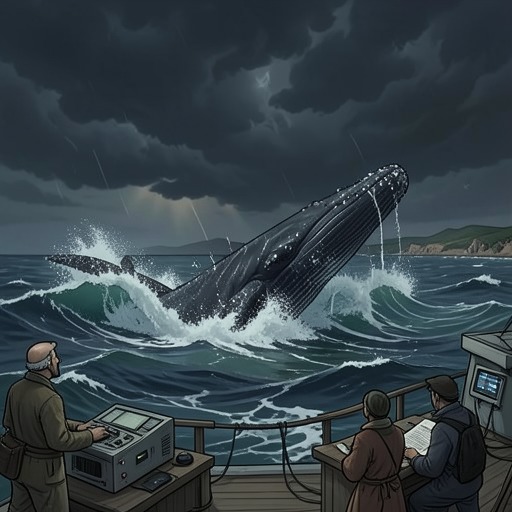
Whales as early warning signals of ecological crisis
The WhaleWhales as early warning signals of ecological crisis describes how cetaceans register changes that human societies often overlook or recognize too late. In the book, their declining populations, altered habitats, strandings, and disrupted social knowledge connect local encounters to wider pressures on the oceans. They are not simply symbols of crisis: their lives depend on food webs, migration routes, soundscapes, and conditions that human activity is changing, making their fortunes evidence of the state of the marine environment.
The ocean as a changing system
The argument begins with a contrast in timescales. The ocean can seem like a stable wilderness, but it is also a dynamic system on which people depend: its smallest organisms sustain human life, its tides and shores shape movement, and its changing conditions affect creatures across immense distances. A calm surface may conceal processes that are difficult to observe directly. The sea’s apparent continuity therefore offers no assurance that its ecological systems remain unchanged.
The annual migration of humpback whales to the Gulf of Maine makes those connections concrete. After spending six months in the Caribbean, the whales travel as much as eight thousand miles north. Their feeding grounds depend on upwelling, where the meeting of the Gulf Stream and cold Labrador currents brings nutrients from the ocean floor into surface waters. Sand lances and herring support the seasonal feeding that allows the whales to build up their reserves. This journey links distant waters, currents, prey, and whale populations: a change in one part of the system can matter far beyond the place where it begins.
Climate change unsettles that relationship. Warming oceans are pushing food sources away from lower latitudes, while the loss of polar ice threatens the habitats and food webs on which whales depend. Krill may diminish as ice-covered feeding grounds change, although nutrients released by melting ice in the Antarctic could have beneficial effects elsewhere. The book stresses that the consequences are uncertain. That uncertainty is itself significant: human activity is altering environmental conditions faster than knowledge can reliably predict what the changes will mean for cetaceans.
Population decline and accumulated pressures
The North Atlantic right whale shows how characteristics that once made a species easy to hunt can leave it exposed in the modern ocean. Its buoyancy keeps it near the surface, and its tendency to travel close to shore brings it into contact with crowded coasts and busy shipping routes. The traits that made it accessible to hunters now increase its vulnerability to vessel strikes. Though it became the first cetacean protected from hunting in 1935, its North Atlantic population has remained static; protective measures, including moving a shipping lane north and requiring vessels to remain five hundred yards from whales, have not removed the danger. Fewer than four hundred North Atlantic right whales remain, and the restricted gene pool and small number of breeding animals put the population’s long-term survival at risk.
Fishing gear adds another pressure to a species already constrained by its small population. More than sixty per cent of North Atlantic right whales have been caught in fishing line, and entanglement can lead to starvation or infection. Ship strikes are also killing more whales than had previously been suspected, including females of calf-bearing age. These deaths have consequences beyond the loss of an individual: when so few breeding whales remain, the survival of even one fertile female may affect whether the population can persist. The Center for Coastal Studies in Provincetown, which Stormy Mayo helped found in 1976, collected data on the species, while Mayo became the first person licensed by the government to rescue entangled whales. Research and rescue thus respond to harms that are both measurable in individual encounters and consequential at the population level.
Commercial hunting has also depleted populations and damaged the transmission of knowledge within them. The oil drilled from Edwin L. Drake’s well in Titusville in 1859 signaled a shift away from sperm whale fisheries, but the search for profitable uses of whale bodies continued through new technologies and new hunting grounds. In 1868 Sven Foyn patented a grenade harpoon that made fast rorquals, including blue whales and fin whales, accessible to commercial hunters. Later, the opening of Antarctic waters supplied whales for industrial products and wartime materials. The historical record makes the scale of extraction visible: around fifty thousand whales died during the two world wars, and the entire South Atlantic humpback population had been driven to extinction by 1918. These losses were not an isolated episode; they formed part of a long period in which economic demand and technical innovation repeatedly shifted hunting onto new species and regions.
Strandings and human-made disturbance
A stranded whale is a conspicuous encounter between marine life and human observers, but its cause is not always clear. Possible explanations include unusual tides, bad weather, sand bars, disease, and an ailing animal leading others toward shore. Sidney Harmer’s observations associated strandings with unusually high or low sea temperatures, sometimes accompanied by winds blowing toward the coast. The competing possibilities caution against treating every stranding as proof of a single cause. At the same time, investigations into strandings can reveal relationships among animal behavior, changing conditions, and the limits of current knowledge.
Some proposed explanations concern the whales’ orientation. Magnetosomes found in cetacean tissues may help whales read the Earth’s magnetic field, much as birds may use magnetic cues during migration. If coastlines shift, magnetic patterns vary, or solar activity disrupts the field, navigation may become less reliable. Whales following such cues can be led into shallow water instead of deeper routes. Studies of sperm whales stranded in the North Sea over three centuries found that ninety per cent of the recorded events occurred when the sun’s activity cycle was below average. These findings suggest possible links, not certainty: strandings are difficult to explain, and the evidence can illuminate patterns without resolving every case.
Other disruptions have more direct human causes. Powerful military sonar, developed since the 1960s to detect submarines, has been associated with strandings near naval exercises. Toothed whales depend on their own sonar, and beaked whales are especially vulnerable because their deep-diving lives require them to rise slowly. Loud pulses can disrupt that behavior and contribute to severe physiological stress. Seismic soundings used in oil surveys may also disturb whales along ancient sonic routes, causing them to turn into the shallow North Sea, where adequate food is harder to find. Modern strandings may be reported more frequently because remote coasts are more accessible and public awareness has increased, so the apparent pattern also has a human observational dimension. The book keeps these explanations in view without claiming that every incident has been solved.
Warnings without certainty
The worldwide moratorium instituted by the International Whaling Commission in 1982, which took effect in 1987 after a delay, did not end the pressures on whales. Noise pollution can damage hearing and compromise the echolocation on which sperm whales rely. Chemical pollutants pass through generations in mothers’ milk; fishing gear kills cetaceans as bycatch; whales also ingest plastic, and warming oceans push food sources into retreat. Because whales move across national boundaries and through international waters, their lives are exposed to human activity even where local protections apply. The pressures accumulate across habitats and jurisdictions rather than arriving as a single, easily contained event.
The book consequently treats whales as early warning signals, not as an infallible measuring instrument. Their declining populations and changing encounters with people show that the ocean is under stress, but the causes and effects are not always immediately legible. Nor does protection alone guarantee recovery: since the moratorium took effect, an estimated twenty-five thousand great whales have died, while the exceptions and continued hunts described in the book demonstrate how contested its reach remains. Whales can expose the distance between an international conservation promise and conditions at sea.
Their warning also concerns what is lost beyond numbers of animals. Studies of sperm whales describe problem-solving, tool use, complex societies, and cultural transmission. Hal Whitehead argues that whaling may have destroyed not only individuals but knowledge about how to use particular habitats. The population’s slow growth—about one per cent a year—makes recovery especially difficult. Hunting can therefore impoverish a species both demographically and socially, erasing learned practices that may matter to the survival of its communities.
That wider perspective gives the warnings their urgency. During the writing of the book, the Yangtze River dolphin was declared extinct; the author also considers a future in which many animal species, including the right whales of Cape Cod Bay, could disappear. The account does not present that future as inevitable or claim that every ecological signal is fully understood. Instead, it sets evidence of population decline, habitat disruption, and cultural loss against the limits of prediction. Whales reveal the consequences of human pressure while showing how much depends on recognizing those consequences before the animals—and the knowledge carried within their communities—are gone.